

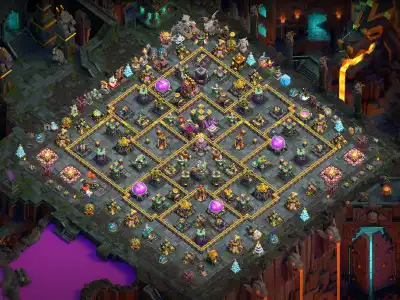
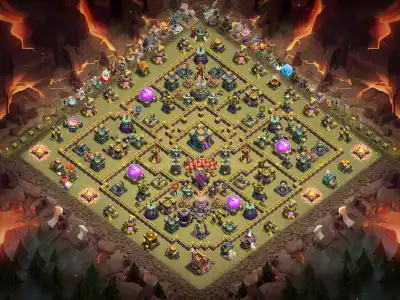

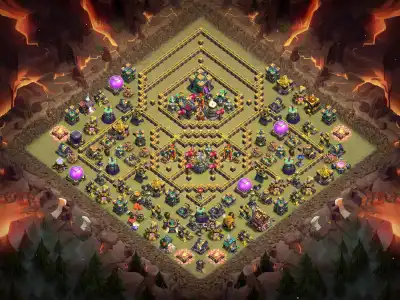


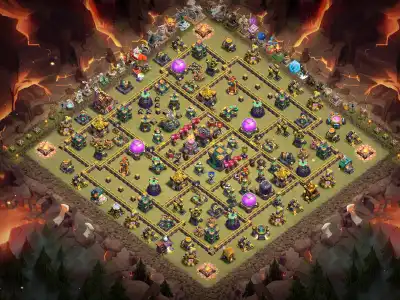
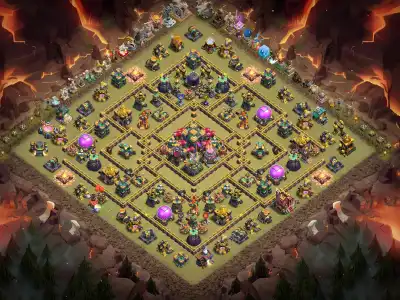



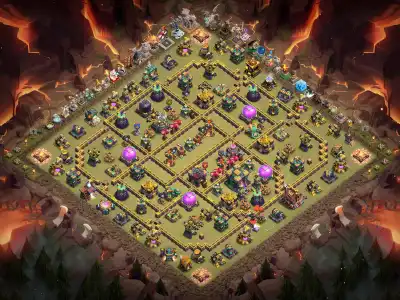
COC Bases: TH14 All Layouts (War, Farming, Defense & More)
All TH14 layouts in one place — war, farming, defense, hybrid, anti-2 star, anti-3 star, anti-air, trophy, and balanced designs for every goal.
Complete Guide to TH14 Base Layouts
Town Hall 14 introduces Hero Pets, defensive Builder’s Huts, and a stronger
Town Hall destruction effect. These mechanics make TH14 base building different
from earlier levels because attackers can strengthen individual Hero entries,
while defending Builders can repair important defensive buildings during an attack.
A strong TH14 base layout should protect the Giga Inferno,
control movement through the Town Hall Poison area, make defensive Builder’s Huts
difficult to remove cheaply, and avoid giving Hero-and-Pet combinations a simple
route through several important defenses.
Use this hub to select a Town Hall 14 layout according to your goal.
War, farming, hybrid, anti-air, anti-2-star and anti-3-star bases use different
Town Hall positions, storage arrangements, trap plans and defensive priorities.
TH14 War Layouts
TH14 war layouts are designed to make a planned three-star attack difficult. They separate important defenses, create uncertain entry choices, protect dangerous back-end compartments and place traps according to likely Hero, Siege Machine and main-army routes.
Choose a war layout when Clan Wars or Clan War Leagues are your main priority. The design should force attackers to divide Heroes, pets, spells and troops between the Town Hall, Eagle Artillery, Scattershots, Inferno Towers, defending Heroes and Clan Castle.
TH14 Farming Layouts
TH14 farming layouts distribute Gold, Elixir and Dark Elixir storages across defended parts of the village. The aim is to prevent one raid from reaching every valuable storage while you upgrade Heroes, pets, equipment, troops, defenses and walls.
Avoid placing all storages in one compact central group. Separating them can force attackers to choose between collecting resources, securing the Town Hall and completing the rest of the base.
TH14 Defense Layouts
Defense layouts are intended for regular multiplayer, trophy defense and ranked play. They balance Town Hall protection, percentage denial, defensive Hero placement, Builder’s Hut support, air coverage and ground coverage.
Choose this category when you want broad protection against several army styles instead of a layout prepared for one specific war opponent.
TH14 Hybrid Layouts
Hybrid layouts combine resource protection with trophy and star defense. Storages can act as high-hitpoint buffers, but they should not create a direct route toward the Town Hall or prevent nearby defenses from supporting one another.
This style is suitable when you want one active Home Village layout for regular progression rather than changing frequently between farming and defensive bases.
TH14 Anti-2-Star Layouts
Anti-2-star layouts focus on making both the Town Hall and the required destruction percentage difficult to secure. They may use a deeply protected Town Hall, dangerous central compartments, defended percentage buildings or routes that require an early Hero and spell commitment.
Choose this style when opponents regularly secure the Town Hall and enough outside buildings without placing the remainder of their army under serious pressure.
TH14 Anti-3-Star Layouts
Anti-3-star layouts may allow a determined attacker to reach the Town Hall but try to prevent the complete clear. Major defenses are separated, troop pathing is less predictable and strong back-end damage remains after the main entry.
This layout type is useful in war when denying the third star matters more than producing the lowest possible destruction percentage.
TH14 Anti-Air Layouts
TH14 anti-air layouts use Air Defenses, Sweepers, Scattershots, air-targeting traps, defensive Heroes and separated defensive zones to disrupt Dragons, Electro Dragons, Balloons and air Siege Machine entries.
Use an anti-air layout when your defense log shows repeated safe funnels, strong chain value, weak Sweeper coverage or predictable access to the Town Hall.
TH14 Trophy and Ranked Layouts
Trophy and ranked layouts should prepare for repeated attacks from different armies, Hero Equipment choices and Pet combinations. They need broad coverage, difficult percentage collection and enough back-end damage to challenge surviving troops.
Review several defensive battles before judging the layout. One unusually effective attack does not necessarily reveal a permanent structural weakness.
What Makes Town Hall 14 Base Building Different?
TH14 introduces the Pet House and the first group of Hero Pets: L.A.S.S.I, Electro Owl, Mighty Yak and Unicorn. A Pet can be assigned to an attacking Hero, giving that Hero additional damage, healing, wall access or support during an entry.
TH14 also allows Builder’s Huts to become defensive buildings. An upgraded Builder’s Hut receives its own attack and releases a Builder who can repair nearby defensive buildings during battle. Once the hut is destroyed, its Builder can no longer continue repairing the village.
The Town Hall retains its multi-target Giga Inferno and releases a Poison Bomb when destroyed. The Poison damages troops while reducing their attack and movement speed, so the path taken after the Town Hall falls is an important part of the layout.
Defensive Builder’s Huts
Builder’s Huts are no longer only corner buildings at TH14. Their Builders can repair nearby defenses, making hut placement relevant to the survival of the Town Hall, Eagle Artillery, Scattershots, Inferno Towers and other important buildings.
Avoid placing every hut beside one central objective. A single entry should not be able to remove several Builders and their supported defenses together.
Hero Pet Attack Routes
Pets strengthen Hero-led attacks and can change how long a Hero survives, which walls it crosses and which defenses it reaches. Check whether one Hero-and-Pet route can remove several valuable buildings before the main army is deployed.
Important defenses should be separated so an attacker must make additional pathing and spell decisions after securing the first target.
How to Place Defensive Builder’s Huts
Builder’s Hut placement is one of the most level-specific TH14 decisions. A hut should support an important defensive area while remaining difficult to remove without a meaningful troop or Hero commitment.
Supporting the Town Hall
A Builder’s Hut near the Town Hall can repair it and nearby defenses while attackers move through the compartment. Keep enough distance between huts so one spell-supported entry does not remove every Builder at once.
Supporting the Eagle Artillery
A hut placed near the Eagle Artillery can make early damage less effective when the attacker cannot immediately remove both buildings. Use surrounding defenses to prevent a safe Queen or long-range troop entry.
Supporting Scattershots
Scattershots often receive early damage from Heroes, Siege Machines or long-range troops. A nearby Builder can help the defense survive longer, but the hut should not create excessive value beside other major buildings.
Supporting Back-End Defenses
A Builder’s Hut can also support a defense intended to remain active near the end of an attack. This may be more useful than placing all Builders in the opening compartment where they are removed immediately.
Common Builder’s Hut Placement Mistakes
- Grouping every hut: one troop group or spell-supported entry may remove several Builders before they provide useful repairs.
- Leaving huts unprotected: outside huts may be destroyed before the main army reaches the defenses they are meant to support.
- Using all huts in the core: this can create excessive value beside the Town Hall, Eagle Artillery and other important targets.
- Ignoring repair relationships: a hut should be close enough to support meaningful defensive buildings rather than occupy an arbitrary tile.
- Forgetting percentage value: easily destroyed huts can provide attackers with safe outside destruction.
Building Around the TH14 Giga Inferno
The TH14 Giga Inferno attacks multiple ground and air units after activation. When the Town Hall is destroyed, its Poison Bomb creates an area that damages troops and slows their movement and attacks.
A strong layout should consider both the approach toward the Town Hall and the route troops take after destroying it. Walls, storages, traps and defensive buildings can keep surviving troops inside the Poison area or force them to take an inefficient route toward the remaining village.
Central Town Hall
A central Town Hall can remain active longer and force attackers through several defensive layers. This position can support anti-2-star designs, but it should not create one compact core containing every major defense.
Offset Town Hall
An offset Town Hall can pull the attacking army away from the Eagle Artillery, Scattershots or dangerous back-end defenses. The route should create a meaningful trade-off instead of offering an inexpensive star.
Teaser Town Hall
A teaser-style Town Hall encourages attackers to enter from a predictable side. The surrounding traps, defending Heroes and defensive coverage must punish that choice, or the Town Hall simply becomes an easy objective.
Town Hall Poison Pathing
Inspect where troops are likely to move after the Town Hall falls. Avoid giving them a direct path out of the Poison area and into the next valuable defensive compartment.
Balancing the Town Hall and Eagle Artillery
The Town Hall and Eagle Artillery are two major objectives that can influence an attacker’s entry choice. Their placement should create competing priorities rather than one obvious route through both.
Separated Objectives
Separating the Town Hall and Eagle Artillery can force attackers to choose between securing the Town Hall early and stopping long-range Eagle damage. The remaining route should still contain enough defenses to punish that choice.
Connected Defensive Zones
Place them in supporting areas only when walls, compartments and spacing prevent one protected troop group from removing both objectives together.
TH14 Hero Pets and Base Design
Hero Pets do not change the defensive buildings available in a layout, but they change how attackers use their Heroes. A base should not assume that an attacking Hero will follow the same route or survive for the same amount of time in every attack.
L.A.S.S.I Routes
L.A.S.S.I stays close to its assigned Hero and can jump over walls. Avoid creating compartments where a Hero and Pet can remove several defenses along one continuous route without entering new defensive coverage.
Electro Owl Chain Value
Electro Owl attacks from range and can chain damage to another target. Spacing between exposed buildings can reduce the number of useful structures reached during an early Hero entry.
Mighty Yak Wall Access
Mighty Yak deals additional damage to walls and can help its Hero enter a compartment. Avoid relying on one wall layer to keep an attacking Hero away from the Eagle Artillery, Scattershot or Town Hall.
Unicorn Healing
Unicorn heals its assigned Hero and can extend a Queen or other Hero entry. Place important defenses so one healed Hero cannot remove an entire side without travelling through additional high-damage coverage.
Hero Equipment and TH14 Pathing
Hero Equipment allows attackers to change the abilities and battlefield roles of their Heroes. A TH14 layout should therefore prepare for more than one expected Queen, King, Warden or Royal Champion entry.
Avoid Straight-Line Value
Do not align several important defenses along one direct route from the deployment edge. Long-range equipment, piercing effects or protected Hero movement may reach multiple targets from the same approach.
Create Separate Hero Objectives
A single Hero should not be able to remove a Scattershot, Inferno Tower, defensive Hero, Eagle Artillery and Town Hall without changing direction or entering a new defensive zone.
Protect Edge Defenses
Check whether important defenses can be removed from outside the village while the attacking Hero remains under Pet, spell or equipment support. Use overlapping ranges to make edge entries more expensive.
Separate Defending Heroes
Defending Heroes placed in different sections create several defensive encounters. This reduces the chance that one spell or equipment activation controls all defensive Heroes at once.
Important Defensive Zones at TH14
TH14 contains several high-value defenses that attackers may try to remove before deploying their main army. Avoid placing all of them within one Hero path, spell area or Siege Machine route.
- Town Hall zone: create meaningful Giga Inferno and Poison value without constructing one overloaded central compartment.
- Builder’s Hut zones: place Builders where their repairs support useful defenses without grouping every hut together.
- Eagle Artillery zone: protect it from simple early removal while avoiding excessive value beside the Town Hall.
- Scattershot zones: cover likely troop groups and avoid making both Scattershots accessible from one entry.
- Inferno Tower zones: balance single-target and multi-target coverage according to the armies appearing in your defense log.
- Clan Castle zone: avoid an activation route that allows attackers to pull defensive troops safely before the main deployment.
- Defending Hero zones: create several defensive encounters instead of grouping all Heroes in one compartment.
- Air-defense zones: separate Air Defenses, Sweepers and air traps so one entry cannot remove the complete air-defense network.
- Back-end zone: preserve enough damage to challenge troops that survive the Town Hall and first major defensive area.
Common TH14 Attack Threats
TH14 attackers can combine Heroes, pets, Hero Equipment, Siege Machines, Clan reinforcements and several ground or air armies. No layout should be described as capable of stopping every possible strategy.
Electro Titan Armies
Electro Titans damage nearby buildings and defending units with their electrical aura. Compact compartments and tightly grouped targets can give them additional value while tanks and Heroes absorb defensive fire.
Separate important defenses and avoid creating one straight ground route through the Eagle Artillery, Scattershots, Inferno Towers and Town Hall.
Druid-Supported Armies
Druids can support troops through healing before transforming into ground units. Layouts should maintain damage across more than one compartment so healing support does not carry the complete army through one central route.
Dragon and Electro Dragon Armies
Dragons, Electro Dragons and Balloons can punish grouped buildings, predictable Air Sweepers, exposed Air Defenses and weak back-end air coverage. Use spacing to reduce chain value and create less direct flight paths.
Hero-Led Entries
Pets and Hero Equipment allow Heroes to remove large sections before the main army is deployed. Check whether one Hero route can reach a Scattershot, Inferno Tower, Eagle Artillery, defensive Hero and Town Hall without changing direction.
Battle Blimp Entries
Battle Blimps can deliver troops toward the Town Hall or another protected compartment while bypassing walls. Place air traps according to realistic Blimp routes instead of scattering them without a clear purpose.
Ice Block Spell Support
The Ice Block Spell can protect friendly troops from most incoming damage, although affected troops temporarily stop attacking and moving. A layout should preserve important defenses outside one protected troop area so attackers still face pressure after the effect ends.
Ground Defense at TH14
Ground armies may use tanks, Heroes, Electro Titans, summoned units, healing support and Siege Machines to create one protected push. Walls remain important, but they should work with building placement and defensive ranges rather than form one simple barrier.
Create Multiple Ground Routes
Use compartments and building offsets to make ground troops choose between objectives. One opening should not connect every important defense in a straight line.
Protect Single-Target Damage
Single-target Infernos and other high-damage defenses can pressure Heroes and durable troops. Protect them from simple early removal and support them with splash defenses that handle smaller units.
Use Giant Bomb Areas Deliberately
Place Giant Bombs where ground troops are likely to group after crossing a wall or changing targets. Trap placement should follow expected movement rather than fill unused gaps.
Preserve Back-End Damage
Keep enough ground-targeting defenses active after the Town Hall falls. A base that uses all of its damage in the opening compartment may become easy to finish.
Air Defense at TH14
Anti-air strength depends on the relationship between Air Defenses, Sweepers, Scattershots, Archer Towers, Wizard Towers, air traps and defending Heroes. One isolated Air Defense is not enough to control a complete flight path.
Reduce Electro Dragon Chains
Increase spacing between valuable buildings where practical. Avoid creating predictable building lines that allow chain attacks to move directly toward the Town Hall or Eagle Artillery.
Review Sweeper Directions
Air Sweepers should protect likely Dragon, Balloon and Blimp routes. After copying a base, confirm that their directions support the actual defensive plan.
Separate Air Defenses
Do not allow one Queen entry, spell group or Siege Machine route to remove several Air Defenses before the main air army is deployed.
Protect the Back-End Air Zone
Preserve Seeking Air Mines, Air Bombs and air-targeting defenses for troops that survive the opening section. Avoid placing every trap along the same obvious entry route.
TH14 War Layout or Trophy Layout?
A war attacker can study the base and prepare a specific army, Pet combination, equipment setup and entry plan. War layouts therefore benefit from uncertain pathing, separated objectives and traps aimed at likely custom attacks.
Trophy and regular defensive layouts may face a broader range of armies over several battles. They need balanced ground and air coverage and should avoid one weakness that can be repeated by many attackers.
Choose a War Layout When
Your priority is preventing a planned three-star attack, preserving difficult back-end defenses and forcing the attacker to divide Heroes, pets, spells and troops between multiple objectives.
Choose a Trophy Layout When
Your priority is broad performance against several army combinations and reducing repeated high-destruction results across multiple defensive battles.
How to Choose a TH14 Layout from This Page
Begin with the intended purpose of the layout rather than choosing the most compact or unusual-looking design. Farming, anti-2-star and anti-3-star bases should be evaluated according to different objectives.
- Choose the correct category: decide whether your main goal is war, farming, trophy defense, resource protection, air defense or star denial.
- Inspect the Town Hall route: identify which Heroes, troops and Siege Machines can reach the Giga Inferno from each side.
- Review Builder’s Hut support: confirm which defenses each Builder is likely to repair and whether the huts are too exposed.
- Check the Eagle Artillery relationship: decide whether it creates a separate objective or excessive value beside the Town Hall.
- Inspect Hero routes: review whether Hero Pets and Equipment can help one Hero remove several major defenses.
- Inspect air coverage: review Air Defenses, Sweepers, Scattershots, traps and likely Dragon or Balloon paths.
- Inspect ground routes: check wall openings, Inferno coverage, Giant Bomb areas and likely smash-army movement.
- Review Town Hall Poison pathing: determine where surviving troops move after the Town Hall is destroyed.
- Check the back end: enough defensive power should remain after the attacker reaches the first major objective.
- Match your upgrade levels: a copied base may perform differently when its Builder’s Huts, Heroes, pets, defenses or walls are still upgrading.
How to Use TH14 Copy Links
Open the copy link for the layout you want and review the complete design in the Clash of Clans Layout Editor. Confirm that every building, wall, trap, defense and Hero position has been placed before saving or activating the base.
If your Builder’s Huts have not all been upgraded into defensive buildings, the copied base may behave differently from a fully developed TH14 layout. Review which defenses your available Builders can support.
After copying, inspect Inferno Tower modes, X-Bow settings, Air Sweeper directions, defensive Hero positions, Clan Castle placement, Town Hall access, Builder’s Hut locations and trap groups.
Treat the copied layout as a starting design. Make targeted adjustments according to your upgrade levels and the attack routes shown in your defensive replays.
Common TH14 Base-Building Mistakes
- Using Builder’s Huts as decorations: their repair support should be connected to meaningful defensive buildings.
- Grouping every Builder’s Hut: one entry may remove several Builders before they provide useful repairs.
- Building one overloaded core: grouping the Town Hall, Eagle Artillery, Scattershots, Clan Castle and defending Heroes can provide excessive value.
- Ignoring Town Hall Poison: troop movement after the Town Hall is destroyed should be part of the base design.
- Leaving one complete Hero route: one Hero-and-Pet combination should not be able to remove several major defenses along a single edge.
- Relying on one wall layer: Pets, Siege Machines and other wall-access tools can open protected compartments.
- Creating excessive chain value: grouped buildings can make Electro Dragon and Electro Owl attacks more efficient.
- Exposing Air Defenses: attackers may remove several air-targeting defenses before deploying the main army.
- Designing only against one army: a ground-focused layout may leave an obvious air route, and the reverse is also true.
- Copying defensive settings without review: Inferno modes, X-Bow settings and Sweeper directions should support the actual design.
- Replacing a base after one replay: evaluate repeated attack patterns before deciding that the complete layout has failed.
When Should You Change Your TH14 Layout?
Adjust the layout when several defensive replays show the same successful entry, Hero-and-Pet route, Siege Machine path, Town Hall approach, Builder’s Hut weakness, air funnel or unprotected back-end compartment.
Begin with a targeted adjustment rather than replacing the complete base. Change a wall opening, move an exposed Builder’s Hut, separate important defenses, alter a trap group, reposition a defending Hero or strengthen the final section of the village.
Review additional defensive battles after each meaningful change. Changing too many elements at once makes it difficult to identify which adjustment improved or weakened the layout.
Why Rotating TH14 Layouts Can Help
Layout rotation can be useful when opponents recognize the same design or when one base repeatedly performs poorly against the armies common in your current league or Clan War environment.
Rotation should be based on defensive evidence rather than a fixed schedule. Keep separate layouts for war, farming, trophy defense and anti-air use when those goals require different Town Hall positions and defensive structures.
How These TH14 Layouts Are Reviewed
Layouts may be community-submitted or editorially reviewed for their Town Hall level, image, category, visible structure and copy-link availability. Publication does not automatically mean that a layout has undergone controlled defensive testing.
Visit the layout review methodology to learn how submissions, descriptions, corrections, review labels and testing information are handled.
Explore this page to choose a TH14 base layout for war, farming, trophy defense, resource protection, air defense or star denial. No Town Hall 14 Clash of Clans base can guarantee a successful defense. Review your defensive replays and adjust Builder’s Hut positions, Town Hall access, defensive Heroes, traps, walls and back-end compartments according to the attacks you actually face.