

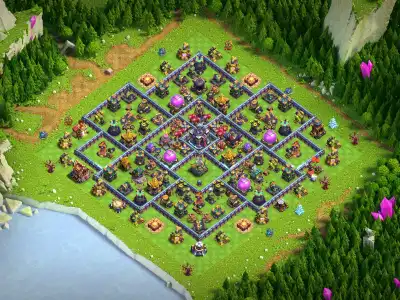
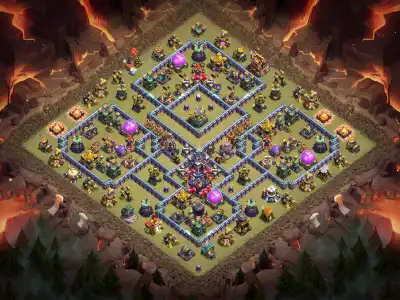
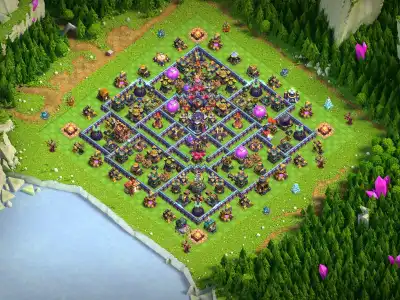
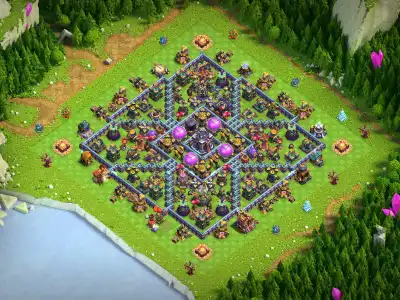
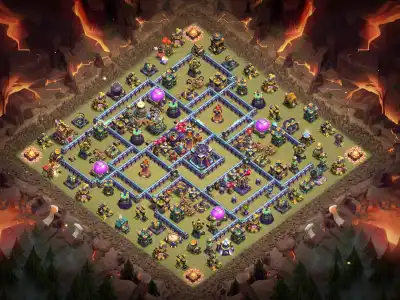
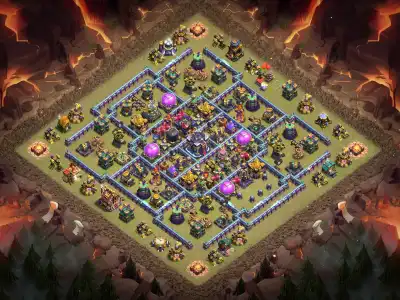
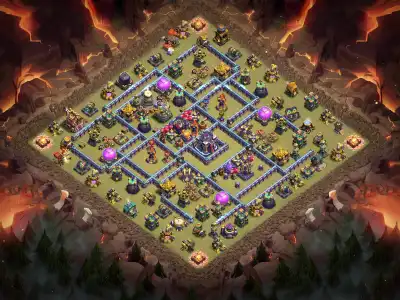
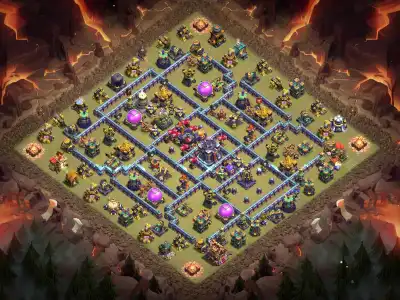
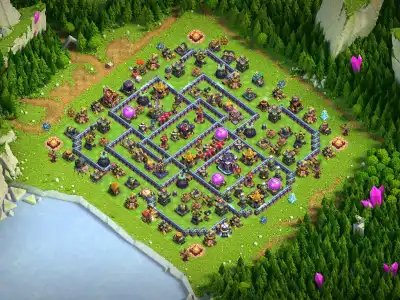
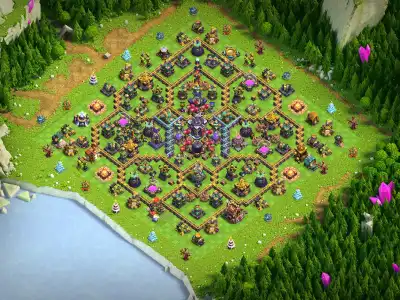
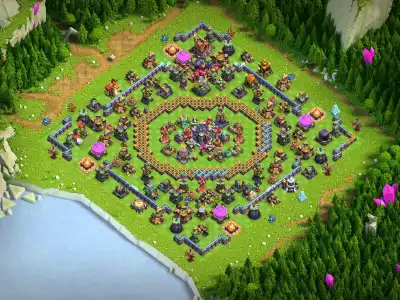

COC Bases: TH15 All Layouts (War, Farming, Defense & More)
All TH15 layouts in one place — war, farming, defense, hybrid, anti-2 star, anti-3 star, anti-air, trophy, and balanced designs for every goal.
Complete Guide to TH15 Base Layouts
Town Hall 15 introduces two defenses that significantly change Home Village
base building: the Monolith and Spell Towers. The Monolith is especially dangerous
against high-hitpoint troops and attacking Heroes, while Spell Towers can support
nearby defenses with Rage, Poison, or Invisibility effects.
A strong TH15 base layout should make these defenses difficult
to remove without concentrating every important building in one small area.
It must also account for the Giga Inferno, Town Hall Poison effect, Eagle Artillery,
Scattershots, Inferno Towers, defending Heroes, Clan Castle troops, traps,
Hero Equipment, pets, and powerful ground and air armies.
Use this hub to choose a Town Hall 15 layout according to your actual goal.
War, farming, hybrid, anti-air, anti-2-star, and anti-3-star bases use different
Town Hall positions, defensive spacing, Spell Tower settings, and pathing decisions.
TH15 War Layouts
TH15 war layouts are designed to make a planned three-star attack difficult. They separate high-value defenses, create uncertain entry choices, preserve dangerous back-end compartments, and place traps according to likely Hero, Siege Machine, and main-army routes.
Choose a war layout when Clan Wars or Clan War Leagues are your priority. The design should force attackers to divide spells and Hero abilities between the Town Hall, Monolith, Eagle Artillery, Spell Towers, Scattershots, and defending Heroes.
TH15 Farming Layouts
TH15 farming layouts distribute Gold, Elixir, and Dark Elixir storages across defended parts of the village. The goal is to prevent one entry from reaching every valuable storage while you continue upgrading Heroes, pets, troops, equipment, defenses, and walls.
Avoid placing every storage in one compact group. Separated storage areas can make attackers choose between collecting resources, securing the Town Hall, and completing the rest of the base.
TH15 Defense Layouts
Defense layouts are intended for regular multiplayer, trophy defense, and ranked play. They balance Town Hall protection, percentage denial, defensive Hero placement, air and ground coverage, and the survival of important defenses throughout the attack.
Choose this category when you want broad coverage against several army styles rather than a base built for one specific war matchup.
TH15 Hybrid Layouts
Hybrid layouts combine resource protection with trophy and star defense. Storages may be used as high-hitpoint buffers, but they should not create an easy route toward the Town Hall or block nearby defenses from supporting one another.
This style is suitable when you want one active Home Village layout for daily progression instead of changing frequently between farming and defensive designs.
TH15 Anti-2-Star Layouts
Anti-2-star layouts focus on making both the Town Hall and the required destruction percentage difficult to secure. They may use a deeply protected Town Hall, dangerous central compartments, defended percentage buildings, or routes that require an early Hero and spell commitment.
This style is useful when opponents regularly secure the Town Hall and enough outside buildings without placing the rest of their army under serious pressure.
TH15 Anti-3-Star Layouts
Anti-3-star layouts may allow a determined attacker to reach the Town Hall but try to prevent the complete clear. Major defenses are separated, troop pathing is less predictable, and strong back-end damage remains after the main entry.
Choose this style for war when denying the third star matters more than producing the lowest possible destruction percentage.
TH15 Anti-Air Layouts
TH15 anti-air layouts use Air Defenses, Sweepers, Scattershots, Multi-Target Infernos, air traps, defending Heroes, and separated defensive zones to disrupt Dragons, Electro Dragons, Balloons, and air Siege Machine entries.
Use an anti-air layout when your defensive replays show repeated safe funnels, excessive chain value, weak Sweeper coverage, or predictable access to the Town Hall.
TH15 Trophy and Ranked Layouts
Trophy and ranked layouts should prepare for repeated attacks from different armies, pets, Hero combinations, and equipment setups. They need broad defensive coverage and enough back-end damage to challenge troops that survive the first major compartment.
Review several defensive battles before judging the layout. One unusually strong attack does not always reveal a permanent structural weakness.
What Makes Town Hall 15 Base Building Different?
TH15 introduces the Monolith and two Spell Towers. These defenses give base builders more control over how the village responds to different attack routes. The Monolith is especially effective against Heroes and high-hitpoint troops, while each Spell Tower can be configured according to the purpose of its compartment.
TH15 does not introduce a completely new Town Hall weapon. Instead, its Giga Inferno receives stronger levels and continues to leave a damaging and slowing Poison effect when the Town Hall is destroyed.
These mechanics make defensive spacing especially important. Grouping the Town Hall, Monolith, both Spell Towers, Eagle Artillery, defending Heroes, and Scattershots may create a powerful core, but it can also provide too much value from one spell-supported entry.
Monolith Placement
The Monolith deals normal damage plus additional damage based on the target’s maximum hitpoints. This makes it particularly dangerous against tanks and attacking Heroes.
Place it where durable troops cannot avoid its range easily, but do not expose it to a simple Queen entry, Royal Champion path, long-range attack, or early Siege Machine deployment.
Spell Tower Placement
TH15 provides two Spell Towers that can be configured independently. Their positions and selected spells should support the surrounding defenses rather than follow the same settings on every copied base.
Separate the towers when placing them together would allow one troop group or spell-supported entry to remove both.
Choosing TH15 Spell Tower Settings
Spell Tower settings can change how an attacker approaches a compartment. Review the selected spell after copying a layout because the setting may not automatically match your defensive goal or the armies appearing in your replays.
Rage Spell Tower
A Rage Spell Tower increases the damage of nearby defenses and defending units. It can support areas containing high-damage buildings, defending Heroes, or several defenses covering the same route.
Avoid placing every major defense inside one Rage area. Although the boosted zone may be powerful, it may also become an attractive target for a concentrated Hero, Siege Machine, or main-army entry.
Poison Spell Tower
A Poison Spell Tower can slow and damage attacking troops within its area. It is useful where support troops, summoned units, or Heroes are likely to remain while fighting through a defended compartment.
Place it where attackers cannot trigger it harmlessly before deploying the main army. Its effect should influence a realistic attack route.
Invisibility Spell Tower
An Invisibility Spell Tower temporarily conceals nearby defensive buildings and units. This can interrupt troop targeting, redirect defense-seeking units, and make a planned entry less predictable.
Test which buildings become invisible together. A poorly selected group may redirect troops toward a more valuable target or create an unintended path.
Using Different Spell Settings
The two Spell Towers do not need to use the same spell. Different settings can give the Town Hall compartment, Monolith area, Eagle Artillery side, and back end separate defensive purposes.
Review defensive replays before changing a setting. Select the spell that addresses a repeated weakness rather than the one that appears strongest without considering placement.
How to Use the Monolith Effectively
The Monolith is one of the most important TH15 defensive targets because its percentage-based damage can threaten troops that normally survive conventional defenses for a long time.
Protect It from Early Removal
Check whether an attacking Hero can reach the Monolith from the deployment edge while remaining under healing, invisibility, or tanking support. Add overlapping coverage if it can be removed without a meaningful commitment.
Cover High-Hitpoint Routes
Position the Monolith where Root Riders, Golems, Electro Titans, Heroes, and other durable troops are likely to travel. Walls and building placement should keep these units inside its range rather than directing them around it.
Support It with Other Defenses
The Monolith focuses on individual targets and can benefit from nearby splash damage, traps, defending Heroes, and other buildings that handle groups of smaller troops.
Avoid an Overloaded Core
Do not automatically place the Monolith beside the Town Hall, both Spell Towers, Eagle Artillery, Clan Castle, and every defending Hero. One successful core entry should not remove most of the base’s defensive strength.
Building Around the TH15 Giga Inferno
The TH15 Town Hall attacks multiple ground and air targets after activation. When destroyed, it leaves a Poison effect that damages troops and reduces their movement and attack speed.
A useful base should consider both the route toward the Town Hall and the route troops take after destroying it. Walls, storage buildings, traps, and nearby defenses can keep surviving troops inside the Poison area or force them into an inefficient path.
Central Town Hall
A central Town Hall can remain active longer and force attackers through multiple defended layers. This style can support anti-2-star layouts, but it should not create one compact compartment containing every major defense.
Offset Town Hall
An offset Town Hall can pull the attacking army away from the Monolith, Eagle Artillery, Scattershots, or strong back-end defenses. Its route should create a meaningful trade-off rather than offer an inexpensive star.
Teaser Town Hall
A teaser-style Town Hall encourages attackers to enter from a predictable side. The surrounding layout must punish that decision with traps, defending Heroes, Spell Tower effects, or difficult access to the remaining base.
Town Hall Poison Pathing
Inspect where the main army travels after the Town Hall falls. Avoid providing a straight route out of the Poison zone and directly toward the next important defense.
Balancing the Town Hall, Monolith, and Eagle Artillery
The Town Hall, Monolith, and Eagle Artillery are three major objectives that can influence the attacker’s entry decision. Their placement should create competing priorities rather than one obvious route through all three.
Separated Defensive Objectives
Separating these buildings can force attackers to choose between early Town Hall security, early Monolith removal, and stopping the Eagle Artillery. The remaining route should still contain enough defensive coverage to punish the choice.
Connected Defensive Zones
Place them in supporting zones only when walls, compartments, and defensive spacing prevent one protected troop group from removing every objective together.
TH15 Hero Pets and Base Design
TH15 players gain access to additional pets including Frosty, Diggy, Poison Lizard, and Phoenix. These pets can change Hero pathing, defensive targeting, and the amount of time an attacking Hero remains active.
Diggy and Defense-Seeking Heroes
Diggy can support a Hero by attacking and stunning defenses. Avoid aligning several important defenses along one simple Royal Champion or other defense-seeking Hero route.
Phoenix and Extended Hero Value
Phoenix can allow an attacking Hero to continue contributing after the Hero would otherwise be defeated. A layout should not depend entirely on one defense ending a Hero entry immediately.
Frosty Support
Frosty and its Frostmites can interfere with defending buildings. Protect important defenses with overlapping coverage so the surrounding area remains dangerous even when one defense is slowed or distracted.
Poison Lizard Pressure
Poison Lizard can add fast support damage to a Hero’s route. Separate defensive Heroes and important support targets so one Hero-and-pet combination cannot remove an entire side without changing direction.
Important Defensive Zones at TH15
TH15 contains enough high-value defenses that placing all of them in one compact area can create excessive spell, Hero Equipment, or Siege Machine value. Spread important targets while maintaining useful overlapping coverage.
- Town Hall zone: create meaningful Giga Inferno and Poison value without building one overloaded core.
- Monolith zone: cover routes used by Heroes and high-hitpoint ground troops while protecting it from early removal.
- Spell Tower zones: select Rage, Poison, or Invisibility according to the purpose of each compartment.
- Eagle Artillery zone: keep it difficult to remove without placing it beside every other major defense.
- Scattershot zones: cover likely troop groups and avoid making both Scattershots reachable from one entry.
- Inferno Tower zones: balance single-target and multi-target coverage according to the armies appearing in your defense log.
- Defending Hero zones: create several defensive encounters instead of grouping all Heroes in one compartment.
- Clan Castle zone: avoid an activation route that allows attackers to pull defensive troops safely before the main deployment.
- Back-end zone: preserve enough damage to challenge troops that survive the Town Hall and first major defensive area.
Common TH15 Attack Threats
TH15 attackers can combine Heroes, pets, equipment, Siege Machines, Clan reinforcements, and several strong ground or air armies. No layout should be described as capable of stopping every strategy.
Root Rider Armies
Root Riders target defenses and break through walls, reducing the value of layouts that depend on one continuous wall layer. Use separated defensive objectives, protected back-end damage, and multiple ground-defense zones.
Electro Titan and Smash Armies
Durable smash armies can combine tanks, support troops, Heroes, pets, and spells inside one protected group. Avoid creating a straight route connecting the Eagle Artillery, Monolith, Town Hall, and both Spell Towers.
Dragon and Electro Dragon Armies
Dragons, Electro Dragons, and Balloons can punish grouped buildings, predictable Sweepers, exposed Air Defenses, and weak back-end air coverage. Use spacing to reduce chain value and create less direct flight paths.
Hero-Led Entries
Hero Equipment and pets allow Heroes to remove large sections before the main army is deployed. Check whether one Hero route can reach a Scattershot, Spell Tower, Monolith, Eagle Artillery, and Town Hall without changing direction.
Battle Blimp Entries
Battle Blimps can carry troops toward the Town Hall or another protected compartment while bypassing walls. Place air traps according to realistic Blimp routes instead of scattering them without a clear purpose.
Recall and Redirected Hero Entries
Recall-based attacks can remove troops or Heroes from one area and redeploy them elsewhere. Avoid depending on the attacker remaining committed to the first side after gaining initial defensive value.
TH15 War Layout or Trophy Layout?
A war attacker can inspect the base and prepare a specific army, equipment setup, pet combination, and entry plan. War layouts therefore benefit from uncertain pathing, separated objectives, and traps placed against likely custom attacks.
Trophy and regular defensive layouts may face a broader range of armies over several battles. They need balanced air and ground coverage and should avoid one weakness that can be repeated by many attackers.
Choose a War Layout When
Your priority is preventing a planned three-star attack, preserving difficult back-end defenses, and forcing the attacker to divide spells, pets, and Heroes between multiple objectives.
Choose a Trophy Layout When
Your priority is broad performance against several army combinations and reducing repeated high-destruction results across multiple defensive battles.
How to Choose a TH15 Layout from This Page
Begin with the purpose of the layout rather than choosing the most compact or unusual-looking design. A farming base, anti-2-star layout, and anti-3-star war base should be evaluated according to different goals.
- Choose the correct category: decide whether your main goal is war, farming, trophy defense, resource protection, air defense, or star denial.
- Inspect the Town Hall route: identify which Heroes, troops, and Siege Machines can reach the Giga Inferno from each side.
- Review the Monolith: confirm that it covers a useful high-hitpoint route and cannot be removed cheaply.
- Check both Spell Towers: confirm their settings and which defenses or units each effect supports.
- Review the Eagle Artillery relationship: decide whether it creates a separate objective or excessive value beside the Town Hall.
- Inspect air coverage: review Sweepers, Air Defenses, Scattershots, traps, and likely Dragon or Balloon routes.
- Inspect ground routes: check wall openings, Monolith coverage, Giant Bomb areas, and paths used by Root Riders and attacking Heroes.
- Check the back end: enough defensive power should remain after the attacker reaches the first major objective.
- Match your upgrade levels: a copied layout may perform differently when its Monolith, Spell Towers, Heroes, pets, or walls are still upgrading.
How to Use TH15 Copy Links
Open the copy link for the layout you want and review the complete design in the Clash of Clans Layout Editor. Confirm that every building, wall, trap, defense, and Hero position has been placed before saving or activating the layout.
After copying, inspect both Spell Tower settings, Inferno Tower modes, X-Bow settings, Air Sweeper directions, defensive Hero positions, Clan Castle location, Town Hall route, Monolith protection, and trap placements.
Treat the copied base as a starting design. Make targeted adjustments according to your upgrade levels and the attack patterns shown in your defensive replays.
Common TH15 Base-Building Mistakes
- Building one overloaded core: grouping the Town Hall, Monolith, Eagle Artillery, both Spell Towers, and defending Heroes can provide excessive value.
- Exposing the Monolith: attackers may remove it before its percentage-based damage affects the main army.
- Using the same Spell Tower setting everywhere: each tower should support the purpose and weakness of its own compartment.
- Creating a harmless Poison Tower trigger: attackers may activate the effect before committing their important troops.
- Ignoring Invisibility pathing: hidden defenses may redirect troops toward an unintended and more valuable target.
- Ignoring Town Hall Poison: troop movement after the Town Hall falls should be part of the design.
- Using one continuous wall plan: Root Riders and other wall-breaking approaches can reduce the value of simple compartment structures.
- Creating excessive chain value: grouped buildings can make Electro Dragon attacks more efficient.
- Leaving a complete Hero route: one Hero should not be able to remove several major defenses along a single edge.
- Designing only against one army: a ground-focused base may leave an obvious air route, and the reverse is also true.
- Copying defensive settings without review: modes, directions, and Spell Tower choices should support the actual layout.
- Replacing a base after one replay: evaluate repeated attack patterns before deciding that the complete layout has failed.
When Should You Change Your TH15 Layout?
Adjust the layout when several defensive replays show the same successful entry, Hero route, Siege Machine path, Spell Tower trigger, Town Hall approach, Monolith weakness, or unprotected back-end compartment.
Begin with a targeted adjustment rather than replacing the complete base. Change a wall opening, move an exposed defense, switch a Spell Tower setting, alter a trap group, separate important targets, reposition a defending Hero, or strengthen the final section of the village.
Review additional defenses after each meaningful change. Changing too many elements at once makes it difficult to identify which adjustment improved or weakened the layout.
Why Rotating TH15 Layouts Can Help
Layout rotation can be useful when opponents recognize the same design or when one base repeatedly performs poorly against the armies common in your current league, ranked group, or Clan War environment.
Rotation should be based on defensive evidence rather than a fixed schedule. Keep separate layouts for war, farming, trophy defense, and anti-air use when those goals require different Town Hall positions and defensive structures.
How These TH15 Layouts Are Reviewed
Layouts may be community-submitted or editorially reviewed for their Town Hall level, image, category, visible structure, and copy-link availability. Publication does not automatically mean that a layout has undergone controlled defensive testing.
Visit the layout review methodology to learn how submissions, descriptions, corrections, review labels, and testing information are handled.
Explore this page to choose a TH15 base layout for war, farming, trophy defense, resource protection, air defense, or star denial. No Town Hall 15 Clash of Clans base can guarantee a successful defense. Review your replays and adjust the Monolith, Spell Tower settings, Town Hall access, defending Heroes, traps, walls, and back-end compartments according to the attacks you actually face.