

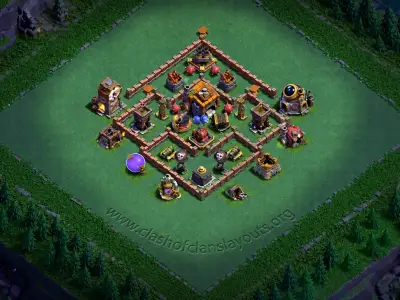
COC Bases: BH7 All Layouts (Builder Hall 7 Base Designs)
All Builder Hall 7 layouts in one place — defense, farming, trophy pushing, and balanced Builder Base designs for competitive Builder Base battles.
Builder Hall 7 Base Layout Guide
Builder Hall 7 expands the strategic demands of two-stage Builder Base defense.
Attackers gain access to the Drop Ship, while defenders unlock the Giant Cannon,
creating new air and ground threats that must be considered across both stages.
A strong BH7 base layout should balance anti-air coverage,
ground pathing, protected objectives, and defensive strength between Stage 1
and Stage 2.
BH7 layouts should not rely on stopping only one army type. Ground attacks may
use the Battle Machine to absorb damage and open a route through important defenses,
while air attacks can use Drop Ships and supporting troops to approach from directions
that ignore walls. Your layout should make the first stage expensive to clear and
leave enough defensive power to challenge the surviving army in the second stage.
BH7 Defense Layouts
BH7 defense layouts distribute useful ground and air coverage across both stages. They protect important defenses from early removal, limit direct routes to the Builder Hall and O.T.T.O’s Outpost, and force attackers to use troops and abilities before reaching the most valuable areas.
BH7 Trophy Layouts
BH7 trophy layouts aim to reduce the total stars and destruction earned across both stages. A strong first stage can weaken the attacking army, while a difficult second stage can prevent surviving troops and reinforcements from collecting easy additional stars.
BH7 Progression Layouts
Builder Base attackers do not steal resources from your storages. Builder Gold is earned through attacks, while Builder Elixir is earned from defensive results. A progression layout therefore focuses on limiting enemy stars and destruction while your defenses, troops, walls, support buildings, and Battle Machine continue to improve.
BH7 Balanced Layouts
Balanced BH7 layouts prepare for both ground and air attacks without placing every important defense in one stage. They combine protected objectives, controlled troop routes, useful anti-air coverage, and enough Stage 2 strength to challenge attackers who complete the first stage.
What Makes Builder Hall 7 Different?
BH7 builds on the two-stage system introduced at BH6 but adds more demanding offensive and defensive mechanics. The Giant Cannon creates a powerful threat against ground armies, while the Drop Ship gives attackers another air-based option that can bypass walls and distract ground-targeting defenses.
These additions make specialized layouts less reliable. A base focused too heavily on ground defense may become vulnerable to air attacks, while a layout that places all anti-air protection together may allow attackers to remove it through one carefully planned entry.
Giant Cannon Unlocks
The Giant Cannon fires powerful shots through ground troops positioned along its firing path. It can threaten grouped units and deal significant damage to the Battle Machine. Its placement should create difficult ground routes rather than allowing attackers to approach it safely from the edge.
Drop Ship Attacks Become Available
The Drop Ship gives BH7 attackers another air troop option. Because air troops ignore walls, both stages need useful anti-air coverage and protected air-targeting defenses. A wall-heavy layout without adequate air protection may be easier to approach from above.
Two-Stage Planning Continues
BH7 attacks still require complete destruction of Stage 1 before the surviving army can enter Stage 2. The first stage should remove troops and force ability usage, while the second stage should challenge the remaining army, Hero Machine, and reinforcement troop.
Battle Machine Remains the Hero Choice
The Battle Copter does not unlock until Builder Hall 8, so BH7 attackers still use the ground-based Battle Machine as their Hero Machine. Ground routes should be designed to keep it under defensive fire and prevent safe access to multiple important targets.
How to Place the Giant Cannon at BH7
The Giant Cannon should influence the path attackers want to take through the base. Avoid placing it where ranged troops can remove it safely or where the Battle Machine can approach it through an undefended outer route. Its firing lane should cross an area that ground troops are likely to enter.
Because the Giant Cannon is available on only one stage at a time, its placement also affects how defensive strength is divided. Placing it in Stage 1 may help damage a full ground army before the second stage, while placing it in Stage 2 may create a difficult final obstacle for surviving ground troops.
Use It in Stage 1 When
Consider placing the Giant Cannon in Stage 1 when ground armies regularly complete the first area with a healthy Battle Machine and several surviving troops. Position it behind other buildings so attackers must remain inside defensive range before they can reach it.
Use It in Stage 2 When
Consider placing the Giant Cannon in Stage 2 when weakened ground armies continue collecting easy stars after clearing the first area. Its shots can pressure surviving troops and the Battle Machine as they move toward O.T.T.O’s Outpost.
Create a Useful Firing Lane
Arrange walls and buildings so common ground routes cross the Giant Cannon’s line of fire. Avoid pointing its strongest coverage toward an area attackers rarely use. Its value depends on predicting troop movement rather than simply placing it in the visual center of the base.
Protect It from Early Removal
Surround the Giant Cannon with enough defensive support to prevent attackers from destroying it without risk. Nearby defenses should punish troops or the Battle Machine while they move into position to target it.
Preparing BH7 Layouts for Air Attacks
The Drop Ship increases the importance of air coverage at BH7. Walls can still influence ground troops and Skeletons, but they do not stop flying units from approaching important targets. Air-targeting defenses should be protected, separated, and positioned so one deployment area cannot avoid most of them.
Separate Air Defenses
Avoid placing every air-targeting defense in one small section. When they are grouped too closely, attackers may remove or distract several of them through one approach. Separation forces air troops to remain exposed for longer as they travel between defended areas.
Protect Firecrackers
Firecrackers should not be placed where they can be destroyed immediately from the deployment edge. Place them behind other structures or within supporting coverage so air troops must spend time under fire before reaching them.
Avoid an Air-Safe Side
Review both stages for a side that contains little or no air coverage. A weak air entry can allow Drop Ships and supporting troops to approach important buildings without receiving enough early damage.
Mix Ground and Air Threats
Drop Ships can create ground distractions while air troops continue attacking. Your layout should not depend entirely on ground-only or air-only defenses. Mixed coverage helps the base respond when the attacking force contains both flying units and ground distractions.
Balancing Stage 1 and Stage 2 at BH7
BH7 offers more buildings and defensive options than BH6, but the basic two-stage challenge remains the same. A powerful Stage 1 is useful only if Stage 2 can still prevent additional stars, while a strong Stage 2 provides little value when the first stage gives attackers an easy clear with most of their army intact.
Stage 1: Reduce Army Strength
Stage 1 should force difficult deployment choices and make attackers use important troop abilities. Protect the Builder Hall, create overlapping coverage, and avoid giving the Battle Machine or air troops a safe route through several valuable targets.
Stage 2: Deny Additional Stars
Stage 2 should challenge surviving troops immediately after deployment. Protect O.T.T.O’s Outpost, cover likely entry routes, and avoid leaving free buildings that allow attackers to establish an easy funnel before reaching the defended area.
BH7 Stage 1 Layout Priorities
The first stage faces the attacker’s full starting army and Battle Machine. It should be strong enough to cause meaningful losses but should not consume every valuable defense available to the base. The objective is to make complete destruction difficult and weaken anything that continues into Stage 2.
Protect Multiple Entry Sides
Ground and air armies may prefer different deployment areas. Inspect the base from every side and avoid creating one route that bypasses the majority of your defensive coverage.
Force Early Ability Usage
Place enough pressure near the opening routes to encourage attackers to use troop or Battle Machine abilities during Stage 1. An army entering Stage 2 without its most useful abilities is easier to contain.
Prevent Safe Percentage
Outside buildings can waste time and influence troop movement, but too many undefended structures provide easy destruction. Use outer buildings where defensive ranges can still punish the troops targeting them.
Do Not Overload the Core
Placing every important building in the center may create excessive value from one successful entry. Separate key targets so attackers must move through more than one defended area to complete the stage.
BH7 Stage 2 Layout Priorities
Stage 2 may face surviving ground troops, air troops, the Battle Machine, and a reinforcement choice selected for the second layout. It should not depend on one predictable counter. Use protected objectives, mixed defensive coverage, and an opening that applies pressure before the surviving army can reorganize.
Protect O.T.T.O’s Outpost
Place the Outpost where attackers must pass through useful defensive coverage to reach it. Avoid exposing it near the edge or aligning it with several other valuable buildings along one simple attack route.
Cover the Stage 2 Opening
Surviving troops should not receive several free targets immediately after deployment. Use defenses and supporting buildings to pressure the army before it establishes a clear path toward the Outpost.
Prepare for Reinforcements
The reinforcement troop can help attackers correct a weakness in their surviving army. Avoid designing Stage 2 to stop only one troop type. A combination of ground and air coverage makes reinforcement choices less decisive.
Limit Direct Objective Routes
Do not create a straight line from the deployment edge to O.T.T.O’s Outpost. Walls and buildings should influence ground movement, while air defenses should cover direct flying approaches toward the objective.
How to Choose a BH7 Layout
Choose a layout by reviewing complete defensive replays rather than focusing only on the final star count. Identify whether attackers succeed with ground armies, air armies, or a particular reinforcement choice. Also check how many troops and how much Battle Machine health survive the first stage.
If attackers regularly fail during Stage 1, avoid weakening that stage without a clear reason. If they reach Stage 2 with limited strength but still earn additional stars easily, improve the second-stage opening and objective protection. The correct BH7 layout is the one that addresses the repeated weakness shown in your own defense log.
Choose Stronger Ground Control When
Improve ground pathing and Giant Cannon coverage when the Battle Machine and ground troops repeatedly move through the same route. Strengthen defensive overlap and remove safe paths toward your most important buildings.
Choose Stronger Air Coverage When
Improve air protection when Drop Ships or other flying troops consistently avoid defensive fire. Separate air-targeting defenses and remove weak entry areas that allow attackers to approach from above with little resistance.
How to Use BH7 Copy Links
Tap an available copy link to open the selected BH7 layout directly in Clash of Clans. Review both stages in the Layout Editor before saving or activating the base. Confirm that all required defenses, traps, walls, resource buildings, and Stage 2 structures are placed correctly.
After copying a layout, compare its defensive distribution with the levels of your own buildings. You can move eligible defenses between stages, adjust trap positions, change wall openings, or relocate outside structures according to the attacks recorded in your defense log.
BH7 Two-Stage Layout Checklist
- Review Giant Cannon placement: confirm that its firing path crosses a route ground troops and the Battle Machine are likely to use.
- Check air coverage on both stages: neither stage should provide an easy approach for Drop Ships or supporting air troops.
- Protect air-targeting defenses: avoid exposing Firecrackers where they can be removed immediately from the edge.
- Balance both stages: do not place nearly every valuable defense in Stage 1 while leaving easy additional stars in Stage 2.
- Check Builder Hall access: Stage 1 should not provide a direct route to the Builder Hall from an obvious deployment area.
- Check Outpost access: surviving troops should face defensive pressure before they can reach O.T.T.O’s Outpost.
- Review reinforcement matchups: Stage 2 should remain useful against more than one troop type.
- Inspect trap routes: place traps where your walls and buildings encourage troops to travel.
Common BH7 Base-Building Mistakes
- Ignoring air attacks: a layout built only around walls and ground pathing may be vulnerable to Drop Ships and other flying troops.
- Exposing the Giant Cannon: placing it near the edge can allow attackers to remove an important ground defense before entering the base.
- Using a poor firing direction: the Giant Cannon provides less value when its main firing lane covers an area attackers rarely enter.
- Grouping all anti-air defenses: one planned entry may allow attackers to distract or remove several air defenses together.
- Making Stage 2 an afterthought: leftover buildings do not create a complete defensive plan around O.T.T.O’s Outpost.
- Overloading Stage 1: attackers who clear an extremely strong first stage may still receive easy additional stars from a weak second stage.
- Using identical weaknesses on both stages: an army that counters Stage 1 should not receive the same easy path through Stage 2.
Tips for Builder Hall 7 Progress
- Study ground and air replays separately: identify whether each stage performs differently against Battle Machine attacks and Drop Ship attacks.
- Test the Giant Cannon position: move it when attackers repeatedly avoid its firing path or remove it without taking meaningful damage.
- Track surviving army strength: note which troops, abilities, and Battle Machine health continue from Stage 1 into Stage 2.
- Improve one stage at a time: changing both stages together makes it difficult to identify which adjustment affected the defensive result.
- Protect both attack types: balance ground control with enough air coverage to prevent one army style from becoming an obvious counter.
- Upgrade important defenses: Giant Cannon placement and strong pathing are more effective when the supporting defenses can deal meaningful damage.
- Review several defenses: do not replace a layout after one result; look for repeated entries, troop choices, and objective routes.
When Should You Change Your BH7 Layout?
Consider adjusting your BH7 layout when several attackers use the same entry, avoid the Giant Cannon through the same route, remove your air defenses early, or reach Stage 2 with a large surviving army. Repeated success from one approach usually indicates a layout weakness that can be corrected.
Begin with the affected section rather than replacing both stages immediately. Change a trap, wall opening, air-defense position, Giant Cannon angle, or outside building and review the next several defenses. Replace the complete layout only when smaller adjustments fail to change the repeated attack pattern.
Explore the layouts on this page to choose a BH7 base layout suited to two-stage defense, trophy pushing, or regular progression. After activating a new Builder Hall 7 Clash of Clans base, compare its performance against ground and air attacks and adjust the stage that repeatedly gives attackers the easiest route to additional stars.