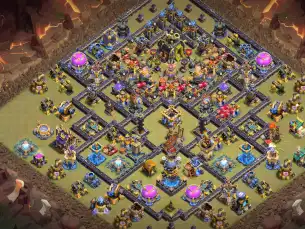
TH19 War Base with Central Town Hall and Wide Rings


Latest Reviews 0
Strategy Explanation
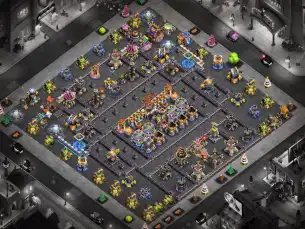
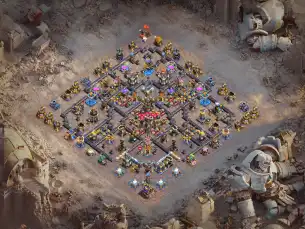
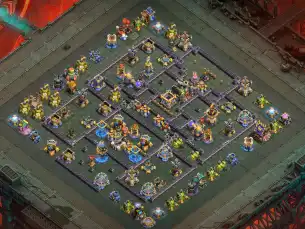
This TH19 war layout uses a compact central core with a ringed outer structure to make clean pathing harder. The Town Hall sits deep in the middle, surrounded by multiple layers of walls and key defenses, so attackers do not get quick value unless they commit heavily into the core. From the image, the base spreads major defenses across both flanks and the center, which means a simple one-side entry is unlikely to reach everything important before troops start drifting around the ring.
The side compartments are wide and fairly symmetrical, with defensive coverage extending from the edges inward. That shape often forces ground troops to split if the funnel is not perfect. The upper and side sections hold enough structure to pull troops away from the center, while the lower half appears built to slow a direct push into the Town Hall compartment. The result is a layout that asks the attacker to solve both the entry and the finish, not just one of them.
Air attacks also have to respect the spacing. Several valuable defenses are not stacked tightly together, so there is less obvious spell efficiency than in a compressed box layout. At the same time, the compact middle still creates heavy pressure once a blimp, heroes, or main air pack reaches it. That balance is the main defensive idea here: give away very little for free on the outside, then make the core exchange costly.
Strengths
The biggest strength is how much protection the Town Hall gets from layers, structure density, and cross-cover from nearby defenses. This is not a layout that offers easy central access.
- Deep Town Hall placement: Attackers need real commitment to claim the center, which is valuable in war where safe two-stars are often the starting plan.
- Ring influence on pathing: The left and right wings can drag troops sideways if the initial funnel is even slightly off.
- Spread defensive footprint: Important defenses are distributed across multiple compartments instead of sitting in one compact block, reducing easy spell value.
- Core pressure: Once troops enter the middle, they face stacked damage and limited room to stabilize.
- Symmetrical side sections: This can make choosing an entry less obvious because neither flank looks clearly softer at first glance.
Ground Attack Pathing
Ground armies will usually try to enter from a lower-side angle or one of the broad flanks, then force a push inward with wall breaks or jump support. The challenge is keeping the army from circling around the side compartments before reaching the Town Hall. This is where the layout does good work. The wide outer sections and staggered compartments can peel off support troops, especially if the attacker hurries the funnel.
For Root Rider style pressure, the base still offers multiple layers to chew through around the core. Even when walls are less of a long-term obstacle, the spread of defenses means the army can thin out before it reaches the middle.
Air Attack Considerations
This layout does not look especially generous to simple straight-line air spam. The base width and defense spread make it harder to cover every critical point with one clean set of spells. The central Town Hall also discourages a careless blimp because the surrounding core is dense and protected.
That said, air attacks with strong funnel support may still like the broad edges. If an attacker can trim one side and lock movement into a narrower channel, the path across the core becomes more manageable. Electro Dragon players will notice some spacing that limits ideal chains, though there are still clustered spots near the core where careless placement could give value.
Hero Entry Pressure
Heroes can be useful here because the outside compartments are not tiny. A King or Queen sent into one wing can remove a meaningful section and help force the main army away from the ring. The defending idea is that even successful hero value on one side does not automatically open the Town Hall, because there is still another layer of defenses and walls waiting inside.
That makes this a solid war choice when you want the attacker to earn every stage of the hit. If you use the copy option, it makes the most sense in wars where forcing a complicated second phase into the core matters more than simply baiting one specific army style.
Why It Fits War
In war, a layout like this is useful because it asks for precision rather than giving up easy percentage. The attacker has to decide between securing the Town Hall early with heavy investment or playing wider and risking a messy finish. That kind of decision pressure is exactly what a good war setup should create.
It is not a mystery base, and strong attackers will still map out entries, but the deep-s