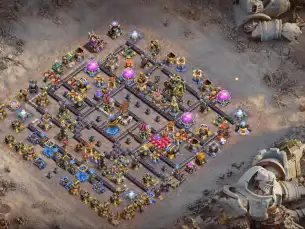
TH19 War Base with Split Core and Offset Town Hall


Latest Reviews 0
Strategy Explanation
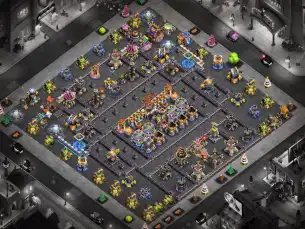
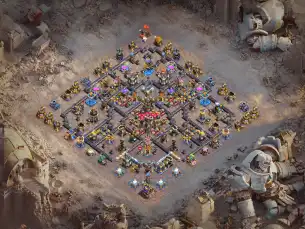
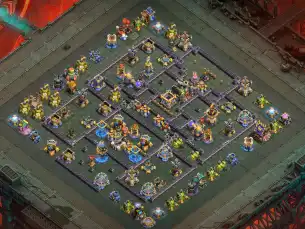
This TH19 layout uses a compact, high-pressure core with the Town Hall placed slightly off center rather than fully centralized. That small offset matters because it changes how attackers approach the middle. A straight push into the core does not automatically claim every major target, and a side entry has to commit deeper than usual to reach the Town Hall while still dealing with the surrounding damage.
The middle of the base is crowded with key defenses and support buildings, which makes the core feel layered even without huge empty gaps. Compartments are broken into several small sections instead of a few giant boxes, so ground armies are less likely to move cleanly from one target to the next. On the outer ring, collectors and utility buildings are spaced in a way that can stretch funnels and delay a clean wrap around the base.
One of the main defensive ideas here is forcing attackers to choose between Town Hall access and wider defensive value. If a Queen Charge or hero push goes in from the Town Hall side, it still has to break multiple layers to get meaningful follow-up value. If the charge starts from another side to remove core defenses first, the Town Hall can remain standing long enough to disrupt the finish. That gives this design clear use in both War and Legend League, where awkward planning often matters more than raw building count.
Strengths
The biggest strength is how much pressure is packed into the center-right portion of the base. The Town Hall is not isolated on an edge, but it also is not sitting in the most obvious dead-center position, which can make target priority uncomfortable for the attacker.
- Offset Town Hall placement: attackers cannot always combine Town Hall value with a full sweep of the core.
- Dense central compartments: the middle holds multiple important defenses close enough to punish overcommitment, but still split enough to avoid giving away everything from one simple entry.
- Uneven outer shape: the left side has more open staging space while the stronger interior mass sits to the right, which can bait troops into less efficient movement.
- Solid anti-spam structure: broad front attacks have to push through several short compartments rather than one easy channel.
- Good defensive overlap: visible heavy defenses and point defenses cover each other well near the core, making late hero pathing harder.
Ground Attack Pathing
Against ground armies, this design is trying to deny clean lane creation. Root Rider and smash-style hits usually want broad access and smooth progression through connected compartments, but here the walls and building angles look more broken up than linear. A careless wide push can split early, especially once troops step from the outside ring into the first interior layer.
That said, if an attacker removes one flank cleanly, the core is compact enough that a committed jump or wall break sequence could still open several high-value tiles at once. This base is strongest when the funnel is messy. It is less comfortable when the attacker gets precise side trimming before sending the main force.
Queen Charge Entry Points
A Queen Charge into the lighter left side looks like the most natural probing option because it can test compartments without running immediately into the thickest concentration of defenses. From there, the attacker can try to shape a route toward the center and force the Town Hall decision later.
The harder version is a direct charge toward the Town Hall side. That path offers obvious reward, but it also walks into the most concentrated defensive area. If you use the copy option for practice, this is the interaction worth testing first: whether your own charge plan reaches the Town Hall cleanly or stalls after taking only partial core value.
Air Attack Considerations
For air attacks, the base presents mixed signals. The compact core means there is meaningful reward if balloons, a blimp, or heroes can break through to the middle. At the same time, the spread of outer buildings prevents a very short flight path from one side of the base to the other, so early funnel discipline matters.
Electro Dragon players should notice that there are several clustered sections in the core and upper compartments, which can create chain value if the entry is not controlled. On the other hand, the overall footprint is not a simple rectangle, so poor setup can send air troops around the edges instead of through the Town Hall section. That balance makes this layout practical for Legend League defense: it does not shut down air by itself, but it asks for cleaner execution than a looser ring base.
Why It Fits War and Legend League
In war, this layout pressures planning because the Town Hall is reachable but not comfortably paired with every other major target. In Legend League, it can punish rushed attacks by forcing a choice between percentage, core control, and Town Hall