TH19 War Base with Offset Core and Anti 3 Star Pathing

Latest Reviews 0
Strategy Explanation
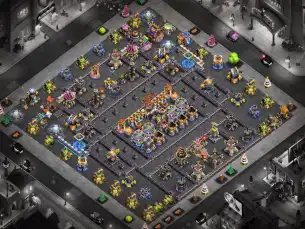
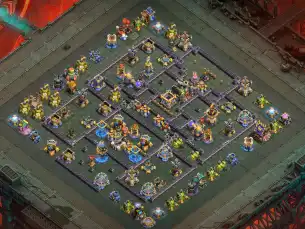
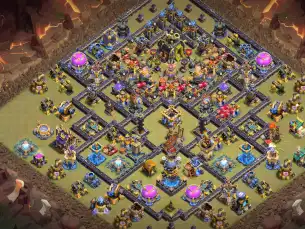
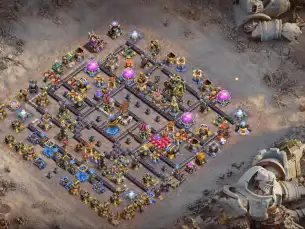
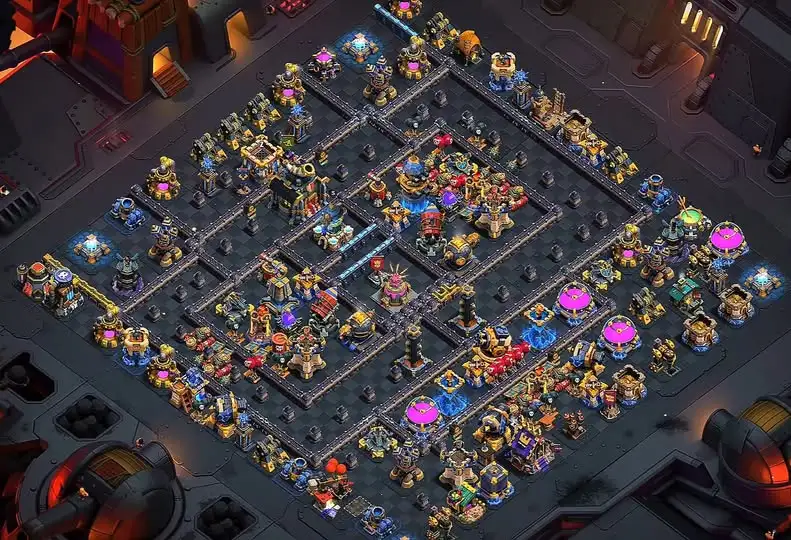
This TH19 layout uses a dense, compartment-heavy center with the Town Hall placed slightly off the exact middle. The key idea is not to give attackers one clean line through the base. Instead, the structure creates several short compartments around the core so troops have to keep reopening walls or commit jump support early. That matters in war because the strongest value is concentrated near the middle, but it is not stacked into one tiny spell-friendly square.
The core contains the heaviest defensive pressure, with major defenses layered so that any push reaching the Town Hall area is still under fire from multiple angles. The center compartments are narrow and connected in a way that can pull ground troops sideways rather than straight through. From the image, the outer ring also includes enough buildings and defenses to shape pathing before the main army reaches the core, which is useful against smash attacks and Root Rider style entries that want a direct lane.
Air attacks also have to deal with spread coverage rather than one obvious sweep. The base does not look open enough to hand out easy chain value through the middle, and the high-value defenses are separated enough that one spell or one quick push should not remove everything at once. In Legend League, that kind of layered damage can force a slower attack pace and make cleanup planning more awkward.
Strengths
The best part of this layout is how the center is protected without becoming too predictable. The offset Town Hall and surrounding compartments create pressure on both sides of a core push, which can break ideal troop control.
- Offset core: The Town Hall is defended from multiple directions instead of sitting on a simple straight-line channel.
- Compartment density: Short internal sections can interrupt pathing for ground troops and make wall-break timing more demanding.
- Spread key defenses: Important damage sources are not all touching each other, which helps reduce oversized spell value.
- Awkward side entries: Several edges appear usable, but none clearly offer a free, low-cost funnel into the center.
- Solid anti-3 structure: The base encourages partial progress and side drift rather than an easy full sweep through the middle.
Ground Attack Pathing
Ground armies will usually want to choose between a broad side push and a more surgical entry. The broad side option risks troops drifting around the outer compartments instead of committing inward. That is where this layout gains value: the buildings on the perimeter can stretch the funnel and delay the main push. A tighter entry with heroes and a siege machine looks more realistic, but that requires clean timing because the base has enough inner layers to punish a stalled advance.
For anti-3 use, that is a good trade. The defender is accepting that attackers may take one section cleanly, but asking them to maintain control after the first break. If you want to test it yourself, the copy option is useful for checking how your own ground army paths from different sides.
Air Attack Considerations
This design gives air attacks a mixed picture. The edges are not completely closed off, so there are possible starting points, but the defense spread through the middle means balloons or dragons still need to cross multiple damage zones to finish the attack. The layout also avoids presenting a giant single compartment where chain-heavy air troops can get effortless central value.
Electro Dragon players in particular may not get ideal line value through the whole base because the important targets are split by walls and spacing. That does not make the base anti-air by itself, but it does force more precise spell placement and better hero support.
Legend League Use
For Legend League, this is a practical style because it pressures attackers to commit early decisions. The base is compact enough to keep defenses supporting each other, but not so symmetrical that every hit will look the same. That usually leads to different entry choices, which is useful over multiple defenses in a day.
It also fits war well because the anti-3 concept is visible in the structure itself: protected core, layered compartments, and no easy straight route to all the premium targets. Strong attackers can still break it with the right plan, but they are unlikely to get a free triple from sloppy pathing.
Core Value Protection
The central value is protected by overlap rather than pure distance from the edge. That is an important distinction. Instead of hiding everything in one isolated island, the layout keeps the key targets close enough to support each other while still forcing attackers to earn access. This usually creates better defensive pressure against hybrid-style pushes, smash armies, and hero-supported entries.
If you want a TH19 war layout that makes attackers solve several small pathing problems before they can stabilize the core, this one does that well.