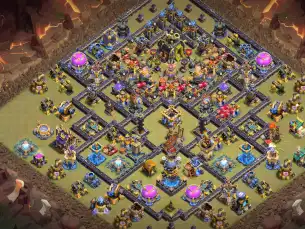
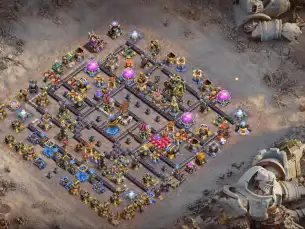
TH19 War Base with Central Core and Wide Ring Pathing


Latest Reviews 0
Strategy Explanation
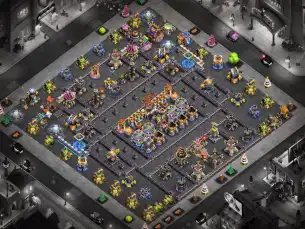
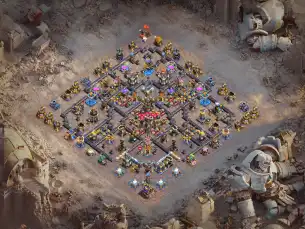
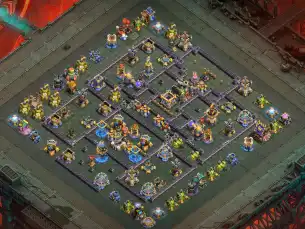
This TH19 layout is built around a compact central core with multiple layers of walls shaping a ring around it. The Town Hall sits deep in the middle section, protected by inner compartments and surrounded by heavy damage from key defenses placed close enough to support each other. The overall idea is clear: make the first phase of an attack feel comfortable on the outside, then punish the push once troops try to break inward.
The outer edge is not overloaded with major targets, which matters because it encourages attackers to commit real funneling before they can reach the center. The side compartments at roughly the left and right of the base hold strong point defenses and create awkward angles for clean entry. At the same time, the top and bottom sections are not simple straight lanes. They bend inward toward the core, which can cause pathing to split if the funnel is even slightly off.
This kind of structure is useful in both war and Legend League because it asks for precise control. Ground armies need to choose between forcing a direct core push or taking the long route around the ring. Air attacks have to deal with separated defenses instead of one easy spell cluster. The center is the part that matters most, and the rest of the layout is arranged to make reaching that center expensive in time, troops, and spells.
Strengths
The biggest strength here is how the layout combines a protected Town Hall with ring-style movement. It does not hand out a clean central line, and that makes multi-phase attacks harder to keep together.
- Deep Town Hall placement: The Town Hall is not exposed to a quick snipe, so 2-star plans still need proper access.
- Layered compartments: Several inner wall sections can slow a direct smash and make jump or wall-break timing more important.
- Wide defensive spread: Major defenses are distributed across the base rather than stacked into one obvious spell target.
- Awkward side entries: The left and right sections look useful for entry, but they do not naturally open the whole base without extra support.
- Ring influence: Troops that drift around the core instead of through it can lose time and miss key targets.
Core Value Protection
The core is the main reason to use this layout. Important damage and the Town Hall are concentrated where support overlaps from several angles. Even if an attacker enters successfully, the middle does not look cheap. Troops stepping into the center are likely to take pressure from multiple compartments at once, which is exactly what you want from an anti-2 and anti-3 design. This also helps against late ability use, because the army should already be under stress before it reaches the deepest section.
Ground Attack Pathing
Ground armies will usually want a clean lane from either the upper-left or upper-right side, but the walls and side compartments make that harder than it first appears. A smash that misses one layer can start circling instead of driving inward. Root Rider style pathing may still break sections open, but the spread compartments mean support troops can lag behind or step sideways. That separation is useful because it reduces the chance of one smooth push clearing the whole base.
For war, this structure works best when the attacker is forced to spend early resources on funneling rather than saving everything for the core. If you use the copy option, test how your defending Clan Castle and hero positions interact with common entry angles so the center stays the hardest part of the attack.
Air Attack Considerations
Against air, the layout benefits from keeping high-value defenses apart and avoiding one obvious straight flight line to the Town Hall. Electro Dragon players may still see some chain potential around the outer buildings, especially where structures sit in neat rows, but the main compartments are spaced well enough to avoid making the whole base chain-friendly. That means air attacks still need a real plan for the middle instead of relying on early snowball value.
Lalo-style hits can path around the ring if one side is trimmed well, so the key defensive idea is forcing hounds, heroes, or spells to be committed before the Town Hall compartment is reached. As a Legend League option, this makes the layout practical because it pressures both safe 2-star attempts and more ambitious triple plans without depending on one gimmick.
Why It Fits War and Legend League
This layout makes sense for players who want a balanced defensive style rather than a trap-looking anti-one-thing setup. The Town Hall is central, the compartments create meaningful decisions, and the outer ring can waste time if the attack loses direction. In war, that helps against overconfident triples. In Legend League, it is useful because attackers often favor reliable pathing, and this design makes reliability harder to maintain all the way through the core.